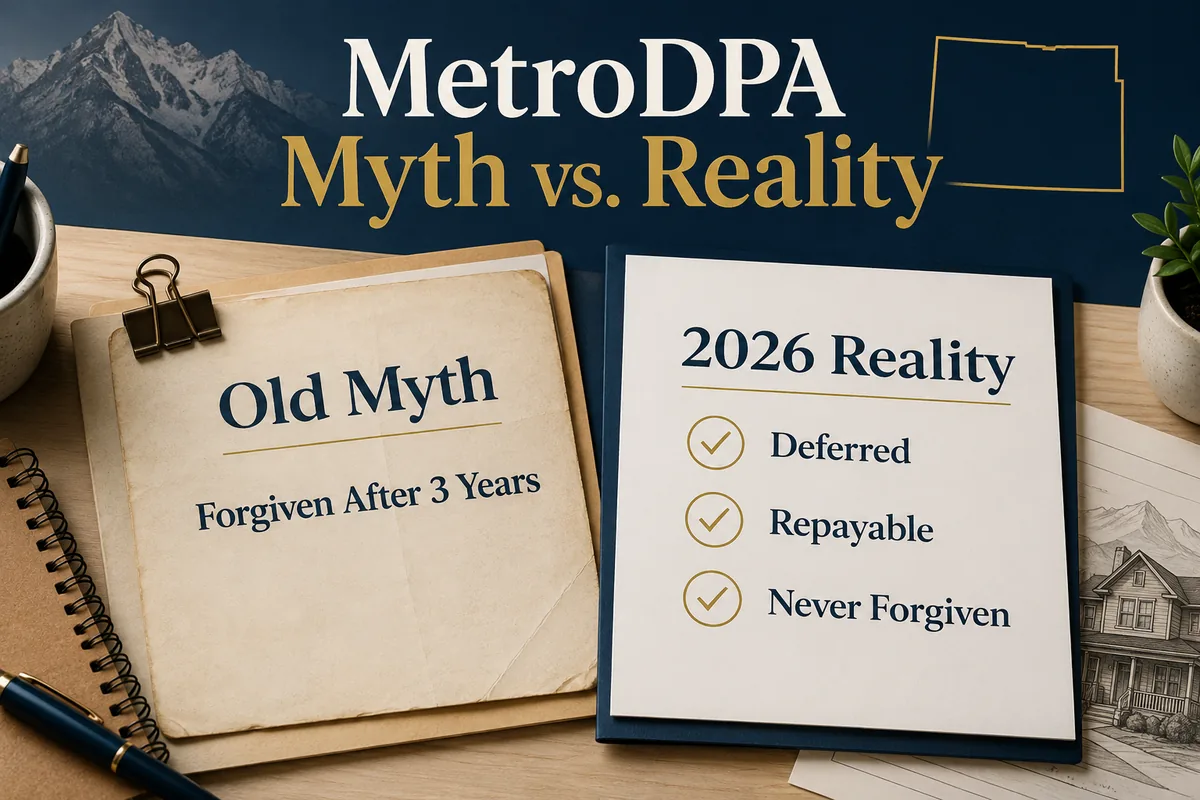
A Colorado buyer goes online, reads a DPA program page, and sees the phrase "forgivable assistance." They build their whole plan around it. Then they sit down with a lender and learn that the program they were counting on changed, and the money is not forgiven at all.
That scenario plays out more often than it should. And with MetroDPA, it is especially common, because a lot of websites still describe it the old way.
Here is the plain-English reality for 2026.
No. Current MetroDPA assistance is not forgiven after three years.
That structure changed on August 30, 2024. Today, MetroDPA down payment assistance is a 0% interest, 30-year deferred second mortgage. You do not make monthly payments on it, and it does not charge interest. But it does not disappear. You repay it when you sell the home, refinance the first mortgage, pay off the first mortgage, transfer the property, or stop using the home as your primary residence.
That one distinction matters more than almost anything else in this article.
What MetroDPA Is in 2026
MetroDPA is a down payment assistance program for eligible buyers purchasing in approved areas across Colorado's Front Range. It is sponsored by the Metro Mayors Caucus, administered by the City and County of Denver, and operated through approved participating lenders.
You do not apply to MetroDPA directly. You work with a participating lender who can offer the program, reserve funds, verify income, confirm property eligibility, and run your exact numbers.
MetroDPA is also not the same as CHFA. It has different rules, different lender tracks, and different repayment terms. If you are comparing Colorado homebuyer assistance programs, make sure you understand which program you are actually evaluating.
MetroDPA may be available in approved areas within these counties: Adams, Arapahoe, Boulder, Broomfield, Denver, Douglas, Elbert, Jefferson, Larimer, and Weld.
But county name alone is not enough. A property typically needs to be inside an approved city, town, or listed unincorporated area. A mailing address can be misleading. Always confirm eligibility with a verified participating lender, not a map you found online.
Reality Check 1: MetroDPA Is Not Free Money
This is the one that catches buyers off guard.
MetroDPA assistance may help lower the cash you need at closing. But the money is still a loan. The current structure is a 0% interest, no monthly payment, 30-year deferred second mortgage that is never forgiven and must be repaid when a repayment event happens.
A "deferred" second mortgage means repayment is delayed. It does not mean repayment is erased.
Think of it as a quiet second loan sitting behind your main mortgage. You do not pay it monthly. It does not grow with interest. But it is still attached to the home. When you sell, refinance, pay off the first mortgage, transfer the property, or stop living there as your primary residence, that second mortgage comes due.
Plain English takeaway: MetroDPA assistance reduces your upfront cash. It does not eliminate the obligation. The repayment is deferred, not erased.
Reality Check 2: The Assistance Amount Depends on the Track
This is where buyers can get confused fast.
Standard MetroDPA Assisted loans generally offer down payment assistance of 3% or 4% of the first mortgage note amount, depending on the loan type, lender track, income category, and what the program is currently offering.
That phrase matters: note amount. MetroDPA assistance is calculated from the loan amount, not the purchase price.
So if you buy a $500,000 home and your first mortgage is $482,500, the assistance is based on $482,500, not $500,000. That gap matters when you are doing the math.
Some rate charts may also show only certain assistance levels available on a given day. In some conventional scenarios, especially for borrowers above 80% of area median income, assistance may be lower than you expect.
That is why you should never rely on one random search result, one old PDF, or one lender landing page. Ask a verified MetroDPA participating lender: "What assistance percentage is available for my loan type today?"
MetroDPA Denver Advantage
Some MetroDPA pages mention 5% assistance. That number is not always wrong, but it is not the standard answer for every buyer.
A special option called MetroDPA Denver Advantage offers 5% down payment assistance for eligible buyers purchasing within the City and County of Denver only. Key details:
- Denver Advantage is limited to the City and County of Denver
- It is available through the TMS lender track
- The assistance is 5% of the note amount
- It is still a 30-year deferred second mortgage
- It is still never forgiven
So when a page says "MetroDPA offers 5%," ask: "Are they referring to standard MetroDPA or Denver Advantage?"
Reality Check 3: The Refinance Trap
This is the section many buyers will wish they had read earlier.
MetroDPA will not subordinate its second mortgage if you refinance your first mortgage or try to open a home equity line of credit.
Here is what that means in plain English. When you refinance, a new lender usually wants to be in first position on the property. If there is already a second mortgage attached to the home, that second mortgage often has to agree to stay behind the new first mortgage. That agreement is called subordination. MetroDPA does not offer it for the assisted second mortgage.
So if you use MetroDPA assistance and later want to refinance, expect to pay off the MetroDPA second mortgage first. Depending on how much assistance you received, that could mean paying back $14,000, $19,000, $24,000, or more at refinance time.
This does not automatically make MetroDPA a bad choice. For many buyers, getting into the home sooner may still be worth it. But if your plan is "I will use DPA now and refinance as soon as rates drop," you need to model that carefully with your lender before closing.
Reality Check 4: The Income Limit Cliff
MetroDPA income limits can look generous at first glance. As of the current 2026 guidance, the income limit for many MetroDPA loan types is $216,000 across participating counties. That generally applies to FHA, VA, USDA-RD, and conventional loans above 80% of area median income.
But conventional loans at or below 80% of area median income may use much lower county-specific limits. A buyer may qualify under one MetroDPA loan type and fail under another, even in the same county.
This is why online summaries can mislead buyers. One page may show a large income number. Another may show a lower one. Both could be correct, referring to different loan types.
The lender has to confirm your county, your loan type, your income category, your household income calculation, and the current program limit. Do not self-disqualify based on an old website. And do not assume you qualify based on a single income number either.
Reality Check 5: MetroDPA Usually Comes With a Rate Trade-Off
Down payment assistance is not magic. Programs that provide money upfront often come with a higher first mortgage interest rate than a similar loan without assistance.
That does not mean the program is unfair. It means there is a trade-off. You may bring less cash to closing, but you may carry a higher monthly payment or pay more over time through the rate on the first mortgage.
The smart question is not: "How much assistance can I get?" The smarter question is: "What does this assistance cost me over the life of the loan, and what does it help me avoid today?"
A participating lender should show you a side-by-side comparison of MetroDPA with and without assistance, alongside other options like CHFA, Chenoa Fund, or a standard loan without DPA. No single option wins every time. The math decides.
What Is MetroDPA EDGE?
MetroDPA EDGE is a lower-rate option inside the MetroDPA program. With EDGE, a 2% discount point is paid upfront in exchange for a lower first mortgage interest rate. That point may be paid by the buyer, by the seller through allowed concessions, or in some structures by program assistance.
EDGE may still include down payment assistance in the 3% to 4% range depending on current offerings and lender track.
EDGE may make sense if you plan to stay in the home long enough for the lower rate to generate real savings, and if the seller is willing to contribute. It may not make sense if you plan to move quickly, need every dollar of assistance for cash to close, or the break-even point does not work for your timeline.
Ask your lender to show the break-even point before deciding.
$500,000 Colorado Purchase Example
This is for education only. It is not a quote, approval, or guarantee. All program rules and amounts must be confirmed with a participating lender.
| Item | Example Amount | Notes |
|---|---|---|
| Purchase price | $500,000 | Illustration only |
| FHA down payment at 3.5% | $17,500 | Buyer's required down payment |
| FHA first mortgage note amount | $482,500 | Assistance calculated on this amount, not the price |
| MetroDPA at 3% of note | $14,475 | Covers most of FHA down payment, deferred second mortgage |
| MetroDPA at 4% of note | $19,300 | May cover full down payment plus some costs, deferred second mortgage |
| Denver Advantage at 5% of note | $24,125 | City and County of Denver only, TMS track, deferred second mortgage |
Even with assistance covering your down payment, closing costs still matter. Budget for lender fees, title costs, escrows, homeowners insurance, property tax prepaids, appraisal, and inspection. MetroDPA reduces your upfront cash burden. It does not erase the cost of buying a home.
Can MetroDPA Help Pay Realtor Commission?
Current MetroDPA program guidance indicates assistance may be used for down payment, closing costs, prepaids, and in some structures to fund Realtor commission, subject to program and loan rules.
That matters because buyer-side agent compensation has become a bigger planning consideration since the real estate commission changes. But do not assume this works automatically in every transaction. Ask your participating lender directly: "Can MetroDPA assistance be used toward Realtor commission in my specific loan structure?"
Homebuyer Education: More People May Need It Than You Think
MetroDPA requires homebuyer education before closing. Here is the part buyers often miss: it is not just every borrower. It is every borrower and anyone whose name will be on title.
So if your spouse, partner, parent, or another person will be on the title, that person may need to complete homebuyer education even if they are not on the loan. Post-closing education does not count.
Handle this early. It is one of the easiest requirements to complete in advance, and one of the most common ways to delay a closing unnecessarily. Approved options may include eHomeAmerica, Fannie Mae HomeView, Framework, Freddie Mac CreditSmart, and CHFA-approved providers. Confirm which course is acceptable with your lender for your exact loan file.
For more on how Colorado homebuyer education works across programs, read our Colorado homebuyer education class finder guide.
Who MetroDPA May Help
MetroDPA may be worth exploring if you are buying in an eligible Front Range area, have income within current program limits, have a credit score that meets program and lender requirements, need help reducing upfront cash, and are comfortable with a repayable second mortgage that will need to be paid off when you sell or refinance.
It may be especially useful for buyers who can afford the monthly payment but are blocked by the upfront cash needed for down payment, closing costs, and prepaids. That is a real barrier for Colorado teachers, first responders, nurses, veterans, public employees, and many other community members who serve here but struggle to afford to live here.
MetroDPA is not a hero-specific program. It is open to eligible buyers regardless of profession. But public service workers may find it particularly relevant because upfront cash is often the wall between serving a Colorado community and being able to own a home in one.
Who Should Be Extra Careful
Be careful with MetroDPA if you plan to refinance soon, expect to move within a few years, are near the income limit, are buying outside a clearly eligible area, or are comparing MetroDPA to CHFA, Chenoa, VA options, seller concessions, or other paths.
Also be careful if you found your information on a website that still says "forgiven after three years." That explanation is outdated and can lead to real financial planning mistakes.
MetroDPA is not something to accept just because it lowers your cash at closing. It is something to compare carefully with other Colorado down payment assistance options.
Questions to Ask a MetroDPA-Approved Lender
- Are you a verified MetroDPA-approved participating lender?
- Which track are you using: US Bank, TMS, or Denver Advantage?
- What assistance percentage is available for my loan type today?
- Is my property in an eligible MetroDPA area?
- Which income limit applies to my county and loan type?
- What is my rate with MetroDPA assistance compared with no assistance?
- What happens if I refinance in two or three years?
- Will MetroDPA subordinate its second mortgage?
- Can assistance be used toward Realtor commission in my transaction?
- Does EDGE make sense for my expected time in the home?
- What will I owe if I sell, refinance, or move out?
If the lender cannot explain these clearly, slow down. The program may be good. The explanation should be clear. Hero HomeReach can help you understand which questions to ask before you sit down with a lender. That is exactly what a free Hero Strategy Session is designed for.
Bottom Line
MetroDPA may still be a valuable option for Colorado buyers who need help reducing upfront cash at closing.
But in 2026, the old "forgiven after three years" explanation is outdated and can lead buyers into a plan that does not match reality. The current version is a repayable, 0% interest, deferred second mortgage that must be paid back when a trigger event occurs.
That means the right question is not just "How much assistance can I get?" The better question is "What will this assistance require from me later?"
Before you choose MetroDPA, speak with a verified participating lender and ask them to run your exact numbers. And if you want to understand the questions to ask before that conversation, Hero HomeReach offers a free session to help you walk in prepared.
Frequently Asked Questions
No. Current MetroDPA assistance is not forgiven after three years. That structure changed in August 2024. Today MetroDPA is a 0% interest, 30-year deferred second mortgage that must be repaid when a repayment event occurs such as selling, refinancing, paying off the first mortgage, transferring the property, or moving out.
No. MetroDPA is not a grant. It is a second mortgage with no monthly payments and no interest, but it must be repaid when a qualifying event occurs. The assistance is deferred, not forgiven.
Standard MetroDPA Assisted options are generally in the 3% to 4% range, based on the first mortgage note amount, depending on loan type, lender track, and current program offerings. Denver Advantage offers 5% for eligible buyers purchasing within the City and County of Denver.
Denver Advantage is a MetroDPA track for eligible buyers purchasing within the City and County of Denver. It offers 5% assistance through the TMS lender track. It is still a never-forgiven 30-year deferred second mortgage and repayment rules are the same as standard MetroDPA.
You can refinance only if the MetroDPA second mortgage is paid off first. MetroDPA will not subordinate its second lien for a refinance or home equity line of credit. That means refinancing requires you to repay the MetroDPA assistance at that time.
No. MetroDPA does not require you to be a first-time buyer. Repeat buyers may be eligible if they meet the income, property, credit, and loan requirements.
Yes. MetroDPA requires homebuyer education for borrowers and for anyone on title, even if that person is not on the loan. Education must be completed before closing. Post-closing completion does not meet the requirement.
MetroDPA EDGE is an option inside the MetroDPA program where a 2% discount point is paid upfront in exchange for a lower first mortgage interest rate. The point may be paid by the buyer, the seller through concessions, or through program assistance depending on the structure. EDGE may still include down payment assistance in the 3% to 4% range. Ask your lender to show the break-even timeline before choosing EDGE.
No. Standard MetroDPA is available in many approved Front Range areas across Adams, Arapahoe, Boulder, Broomfield, Denver, Douglas, Elbert, Jefferson, Larimer, and Weld counties. Denver Advantage, however, is limited to the City and County of Denver only.